
Short answer: Two weeks is enough to see Vietnam from Hanoi to Ho Chi Minh City if you pick five bases, not ten. Spend about 5 days in the north (Hanoi, Ha Long or Lan Ha Bay, Ninh Binh), 3 days in the centre, and 4 to 5 days in the south. Fly the long jumps, take the train or road on the short ones, and keep one flexible day for weather.
This guide gives you a day-by-day route, the real transfer time for every leg, and the swaps that make sense in different months. Train times and fares were checked in November 2026. They change, so confirm before you book.
The 2-week route at a glance
The route below uses 13 nights and 5 main bases. It moves in one direction, north to south, so you never backtrack more than a couple of hours.
| Days | Base | Nights | How you get there | Transfer time |
|---|---|---|---|---|
| 1–2 | Hanoi | 2 | International flight | Airport to Old Quarter about 45–60 min |
| 3–4 | Ha Long or Lan Ha Bay | 1 (on board) | Cruise shuttle from Hanoi | 2.5–3.5 hours by road |
| 4–6 | Ninh Binh | 2 | Train or limousine van from Hanoi | Train 2h08–2h16 |
| 6–7 | Night train to Hue | 1 (sleeper) | Reunification Express | About 10–13 hours |
| 7–9 | Hue, then Hoi An | 3 | Train or car over the Hai Van Pass | Hue–Da Nang about 3 hours by train |
| 10–13 | Ho Chi Minh City + Mekong Delta | 4 | Flight from Da Nang | About 1.5 hours in the air |
| 14 | Fly home | – | Tan Son Nhat airport | – |
Why this order? International flights into Hanoi and out of Ho Chi Minh City are easy to find, and the north is the part of the trip most affected by cold or fog. Starting there gives you room to shuffle days if a cruise is cancelled.
Before you lock dates: the weather is different at each end
Vietnam runs about 1,700 km north to south, so a single trip crosses three climates. The month you travel decides which part of this route needs a backup plan.
- North (Hanoi, Ha Long, Ninh Binh, Sa Pa): Cool and often grey from December to February. Hanoi's coldest month, January, averages about 16.4°C. Summer is hot and humid, with July averaging about 29°C.
- Centre (Hue, Hoi An, Da Nang): The rainy season peaks in October and November. Da Nang averages about 628 mm of rain in October alone, and storms can disrupt travel from August to November.
- South (Ho Chi Minh City, Mekong): Dry from December to April, wet from May to November, usually as short, heavy afternoon showers.
The easiest months for the full north-to-south line are usually March and April. For a region-by-region breakdown, read our guide to the best time to visit Vietnam. Climate figures are long-term averages (Wikipedia climate tables, checked November 2026), not a forecast.
Days 1–2: Hanoi
Give Hanoi two nights. Day 1 is for landing, sleeping and a slow evening walk; day 2 is your real sightseeing day.
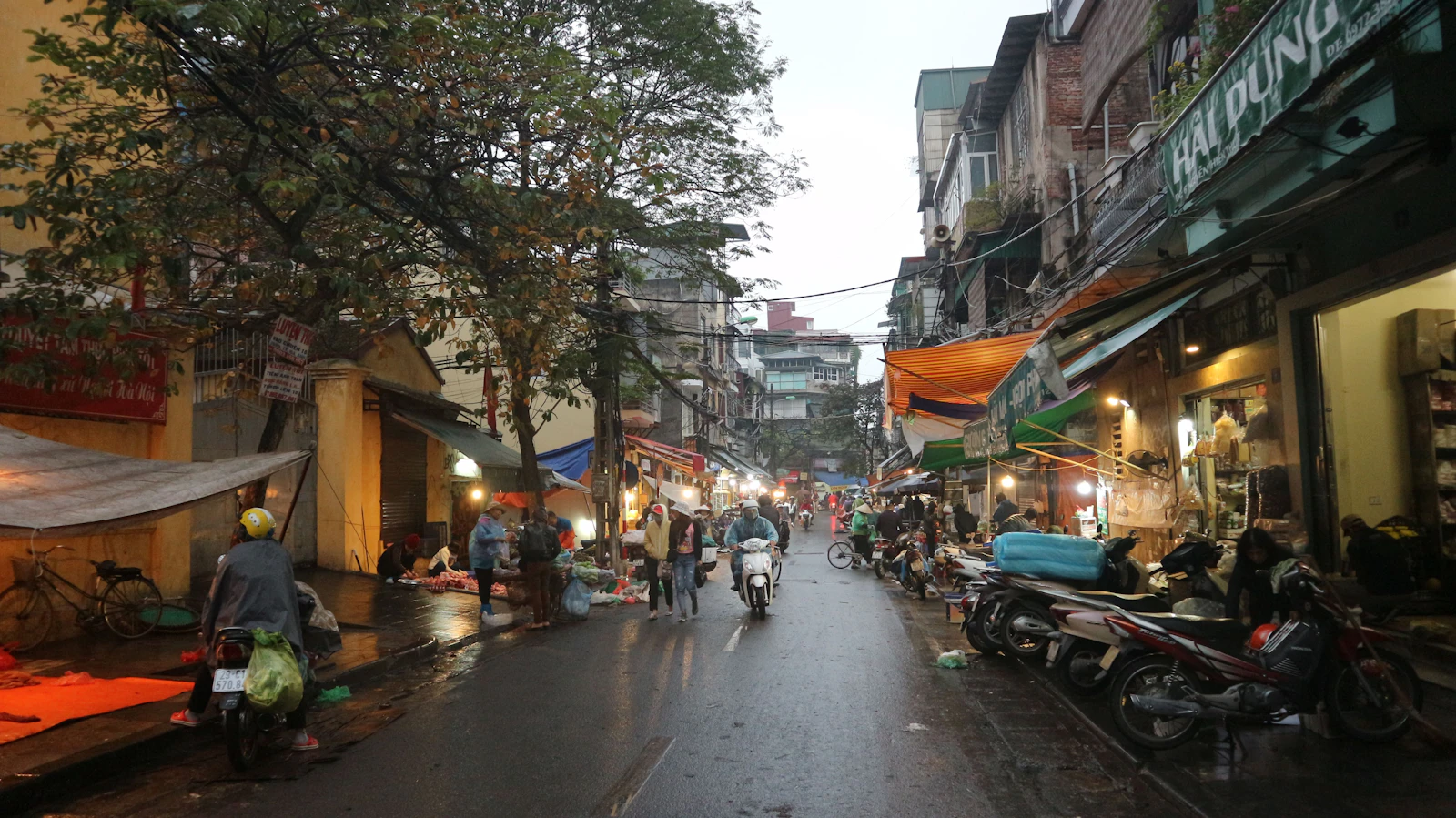
Base yourself in or near the Old Quarter so you can walk to Hoan Kiem Lake, the street-food lanes and the train station. A good full day looks like this:
- Morning: Ho Chi Minh Mausoleum area and the Temple of Literature, before the heat and the tour groups.
- Afternoon: A museum break (the Vietnam Museum of Ethnology or Hoa Lo Prison), then coffee.
- Evening: Street food around the Old Quarter, and the weekend walking streets around Hoan Kiem Lake if you are there Friday to Sunday.
Use day 2 to sort practical things too: a local SIM or eSIM, some cash in Vietnamese dong, and train tickets for later legs if you have not booked them yet. The official railway site is dsvn.vn. Third-party platforms such as 12Go and Baolau charge a little more but are often easier to use with a foreign card.
Days 3–4: Ha Long Bay or Lan Ha Bay overnight cruise
Do one night on the water, not a day trip. A day trip from Hanoi spends 5 to 7 hours on the road for about 4 hours on the bay.

Ha Long Bay sits about 170 km east of Hanoi, and the road transfer takes 2.5 to 3.5 hours depending on traffic. Most overnight cruises leave from Tuan Chau International Passenger Port and include a shuttle from the Old Quarter. Check this when you book, because budget cruises often do not include it.
Ha Long or Lan Ha? Ha Long is the classic, with the most boats. Lan Ha Bay, reached from Hai Phong or Cat Ba, has similar limestone scenery and is often quieter. Either works for this route, as long as the cruise brings you back to Hanoi by early afternoon on day 4. For fees, crowds and the new cross-bay route, see our Ha Long Bay vs Lan Ha Bay comparison.
Weather backup: Local authorities can suspend cruises when storms are forecast, mostly in summer and early autumn. Book with an operator that allows a free date change, and keep day 2 in Hanoi flexible so you can swap it with the cruise.
Days 4–6: Ninh Binh
Ninh Binh gives you karst scenery on land and river. Two nights let you see it without rushing.

From Hanoi, the train covers 115 km in about 2h08 to 2h16, with soft seats from around 210,000 VND (fares checked November 2026). Limousine vans take roughly 1h50 to 3h15 and drop you at your hotel, which is easier with big bags. On day 4 you come back from the cruise in the early afternoon, so an evening train or van to Ninh Binh fits well.
Plan day 5 around the river boats:
- Trang An: A longer boat loop through caves and temples. It is a UNESCO World Heritage site.
- Tam Coc: A shorter, gentler boat ride past rice fields, best when the rice is green or golden.
- Hang Mua viewpoint: Several hundred steps to a ridge with the best view over the valley. Go early or late to avoid the heat.
Most people choose either Trang An or Tam Coc for the boat ride, not both. Trang An is better if you only do one.
Day 6 night: the sleeper train from Ninh Binh to Hue
Here is a move most itineraries miss: you do not need to go back to Hanoi. The north–south trains stop at Ninh Binh, so you can board the night train there and wake up in Hue.
From Hanoi, the full run to Hue is 688 km and takes 12h30 to 15h05. The fastest train, SE3, leaves Hanoi at 19:20 and reaches Hue at 07:50 (timetable checked November 2026). Boarding at Ninh Binh cuts about two hours off that. A 4-berth soft sleeper from Hanoi to Hue costs about 1,140,000 to 1,220,000 VND on the official fare table; from Ninh Binh it is slightly less.
The trade-off is honest: you save a hotel night and the backtrack to Hanoi, but sleep on a train is lighter than in a bed. If you would rather fly, go back to Hanoi and take the 1h20 flight to Hue, or fly straight to Da Nang.
Days 7–9: Hue and Hoi An (the central coast)
Spend one night in Hue and two in Hoi An. Between them, the train from Hue to Da Nang takes about 3 hours and runs along the Hai Van Pass coastline, one of the prettiest stretches of the whole line.
In Hue, focus on the Imperial City and one or two royal tombs. In Hoi An, walk the Ancient Town early in the morning and again after dark, when the lanterns are lit. For day-by-day detail on this leg, see our sister site's Da Nang, Hoi An and Hue 5-day itinerary.
October–November swap: This is the wettest time on the central coast, and Hue and Hoi An can flood. If you travel then, cut the centre to one or two nights and add the time in the south, or fly to Da Lat, which is in its dry season from November to April.
Days 10–12: Ho Chi Minh City
Fly from Da Nang to Ho Chi Minh City on the morning of day 10. The flight takes about 1.5 hours, while the train takes well over 15 hours, so flying is the clear choice for this leg.
Three nights is a comfortable minimum. A simple split:
- Day 10: Arrive, check in around District 1 or District 3, and walk the area around Ben Thanh Market and Nguyen Hue walking street in the evening.
- Day 11: War Remnants Museum, the Independence Palace, the Central Post Office, then a street-food evening.
- Day 12: Cu Chi Tunnels. They sit 60 to 70 km northwest of District 1, about 1.5 to 2 hours each way by car. Ben Duoc is quieter than Ben Dinh. Treat it as most of a day, not a quick morning.
Avoid leaving the city between 7:00 and 8:30 am, when traffic out of District 1 is at its worst.
Day 13: the Mekong Delta
For a 2-week trip, a day in the delta is enough. Choose between a day trip and one night away.

- Day trip (My Tho or Ben Tre): About 2 hours each way. You get boat rides on small canals, orchards and coconut workshops. It is curated, but easy.
- One night in Can Tho: About 3.5 hours each way, which is too far for a day trip. It is the base for the Cai Rang floating market, which is busiest around sunrise. Our guide to the Mekong Delta floating markets explains which markets still trade and how to book a boat.
If you want the floating market, move one Ho Chi Minh City night to Can Tho and come back on the afternoon of day 14, leaving plenty of time before an evening flight.
Swap options: Sa Pa, Phu Quoc or a slower pace
The route above is a template. Here are the three most useful swaps, and what each one costs you in time.

| Swap | Replace | Getting there | Best months |
|---|---|---|---|
| Sa Pa (2 nights) | The cruise, or one Hanoi day + one Ninh Binh day | Night train Hanoi–Lao Cai 7h35–7h50, then 38 km by road; or a limousine van in about 4h45–6h | September to mid-November for golden rice terraces |
| Phu Quoc (2–3 nights) | The Mekong day and one city day | About 1 hour by air from Ho Chi Minh City | December to March (dry season) |
| Da Lat (2 nights) | One central night and one city day | Short flight from Da Nang or Ho Chi Minh City | November to April (dry season) |
For Sa Pa, the official soft-sleeper fare from Hanoi to Lao Cai is about 440,000 to 460,000 VND (checked November 2026). Trains leave Hanoi between 21:45 and 22:40, so you lose no daylight.
If 14 days feels rushed, drop the overnight cruise or the Mekong, not the buffer. One quiet day on a long trip pays for itself.
Fly, train or bus? A leg-by-leg decision
Rule of thumb: take the train or road for anything under about 4 hours, a sleeper train if it saves a hotel night, and a flight for anything longer.
| Leg | Best option | Why |
|---|---|---|
| Hanoi – Ninh Binh | Train or limousine van | About 2 hours either way; no airport |
| Hanoi – Ha Long | Cruise shuttle | Door-to-pier, 2.5–3.5 hours |
| Ninh Binh – Hue | Sleeper train | Saves a hotel night and a backtrack |
| Hue – Da Nang / Hoi An | Day train or car | About 3 hours, coastal scenery |
| Da Nang – Ho Chi Minh City | Flight | About 1.5 hours vs well over 15 by train |
| Hanoi – Ho Chi Minh City (end to end) | Flight | About 2 hours vs 32h45 on the fastest train |
The whole railway is 1,726 km long, and even the fastest train, SE1, takes 32h45 from Hanoi to Saigon (checked November 2026). Riding it end to end is a fun experience, but on a 14-day trip it costs you almost two days.
For more on transport, see our What to do section, where we cover getting around in more detail.
For journey times, real fares, booking sites and baggage rules on each leg, see our guide to getting around Vietnam. To budget the whole route, see Vietnam travel cost per day.
Dates to watch: Tet and public holidays
Avoid building this route around Tet, the Lunar New Year, unless you want to see the festival itself. Tet falls on 6 February 2027 and 26 January 2028.
In the days around Tet, many family-run restaurants, shops and some museums close, and domestic flights and trains sell out early and cost much more. The 30 April–1 May holiday and the Christmas–New Year period are also busy. If your dates overlap, book transport first and accommodation second.
Frequently asked questions
Is 2 weeks enough for Vietnam?
Yes, for one main line from north to south with five bases. It is not enough to add Ha Giang, Sa Pa, Phu Quoc and the Mekong on top of that. Choose one or two extras at most.
Should I go north to south or south to north?
Either works. North to south suits most trips from December to April, because the north is coolest early in the year and the south is dry. If your flights are cheaper into Ho Chi Minh City, just reverse the route.
How do I book Vietnam trains?
The official site is dsvn.vn. Platforms such as 12Go and Baolau resell the same tickets with a small fee and are often easier for foreign cards. Book sleeper berths a few days ahead, and weeks ahead around holidays.
Can I skip Ha Long Bay?
Yes. Ninh Binh gives you similar limestone scenery on land and river, without a long transfer. If you skip the cruise, use the day for Sa Pa or an extra day in Hanoi.
What is the best month for this itinerary?
March and April are usually the best balance across all three regions. December to February is good too, but bring a jacket for the north.
Do I need a buffer day?
Yes, especially from August to November, when storms can cancel cruises and disrupt the central coast. One flexible day in Hanoi is the easiest place to keep it.
Sources checked November 2026: Vietnam Railways timetables and fares as published on vietnamtourism.com, Wikipedia climate tables for Hanoi, Da Nang and Ho Chi Minh City, and the Tet date table. Times and fares change, so confirm before booking.