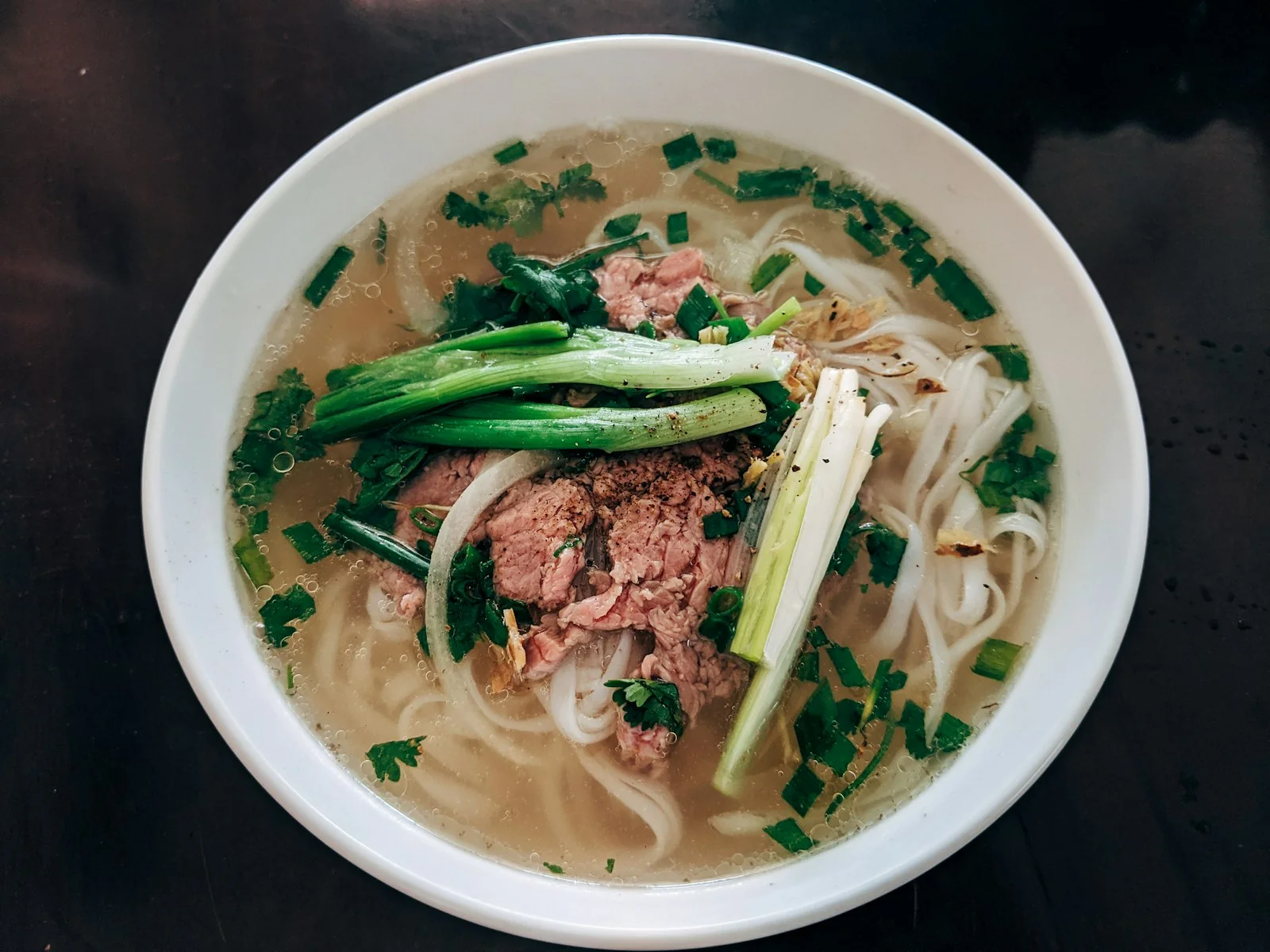
Short answer: Northern vs southern pho comes down to the broth and the table. Hanoi pho is a clear, savoury beef or chicken broth with flat rice noodles and spring onions, seasoned with lime, chilli or garlic vinegar. Saigon pho has a sweeter, darker broth and arrives with bean sprouts, fresh herbs, hoisin and chilli sauce so you build the bowl yourself.
Last updated: November 2026
Northern vs southern pho: what is the difference?
The main difference is that northern (Hanoi) pho is built around a clear broth with very few add-ons, while southern (Ho Chi Minh City, often still called Saigon) pho is sweeter and comes with a plate of herbs and two sauces. Both use the same base: beef or chicken bone broth, flat rice noodles (bánh phở) and sliced meat.
The MICHELIN Guide describes a Hanoi bowl as flat rice noodles, a clear broth, chicken or beef (never both), spring onions and coriander. In Ho Chi Minh City the same guide notes meatballs, onions, a mound of herbs and a broth that tends to be darker, cloudier and sweeter.
| Feature | Northern pho (Hanoi) | Southern pho (Ho Chi Minh City) |
|---|---|---|
| Broth | Clear, savoury, the main event | Darker, sweeter; often sweetened with rock sugar or daikon |
| In the bowl | Noodles, one meat, spring onions, coriander | Noodles, often mixed beef cuts and beef balls, onion, herbs |
| On the side | Lime, fresh chilli, garlic vinegar; sometimes fried dough (quẩy) | Bean sprouts, Thai basil, sawtooth coriander (ngò gai), lime, chilli, hoisin, chilli sauce |
| Eating style | Taste the broth, add little | Season the bowl to your own taste |
| Typical shop | Specialist that sells only beef or only chicken pho | More toppings and combinations in one bowl |
What does Hanoi pho taste like?
Hanoi pho tastes clean and savoury: the broth carries the flavour, and the garnish is limited to spring onions and a little coriander. Locals add a squeeze of lime, sliced chilli or a spoon of garlic-chilli vinegar, and rarely use herbs or hoisin because they believe it hides the broth, according to a December 2025 report by VnExpress International.
Many old Hanoi shops are single-product specialists. A family brand often sells only beef pho (phở bò) or only chicken pho (phở gà), and the city had nearly 700 pho shops in 2023, according to the heritage file summarised by Nhân Dân. Some shops also offer fried dough sticks (quẩy) to dip into the broth.
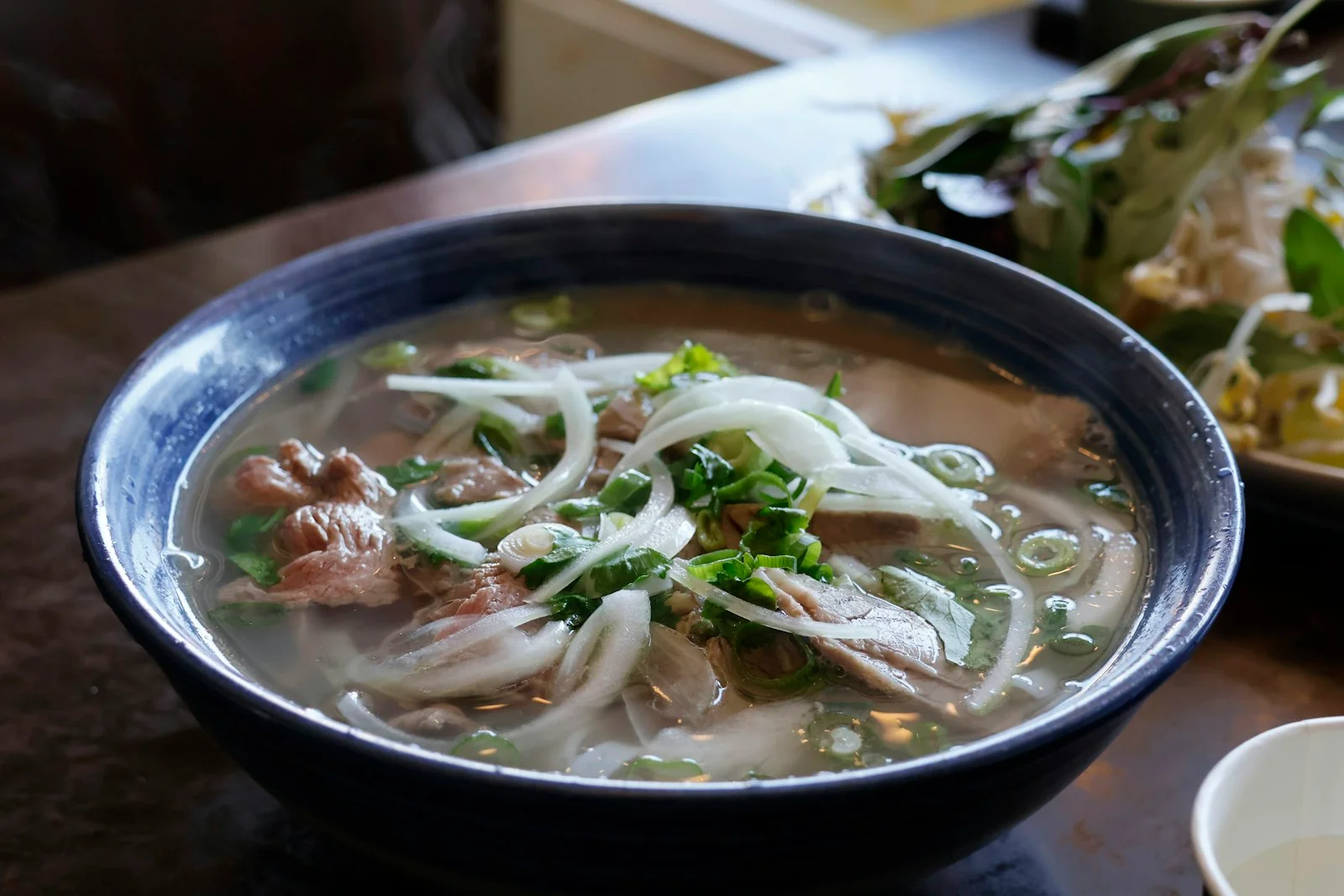
Hanoi is also where pho has the strongest official status. In August 2024 Vietnam's Ministry of Culture, Sports and Tourism added Hanoi pho to the national intangible cultural heritage list under Decision 2328/QĐ-BVHTTDL (Nhân Dân). The same report notes that pho was sold from shoulder poles on Hanoi streets around 1907 to 1910.
Common Hanoi variations worth knowing
- Phở bò: beef pho, the original form. Beef pho predates chicken pho, according to the MICHELIN Guide.
- Phở gà: chicken pho, usually with a lighter broth and torn or sliced chicken.
- Phở cuốn: uncut sheets of pho noodle rolled around stir-fried beef and herbs, eaten with a dipping sauce rather than broth.
- Phở xào and phở chua: stir-fried pho noodles and a sweet-and-sour dry version, often sold at the same shops as phở cuốn.
What makes Saigon pho different?
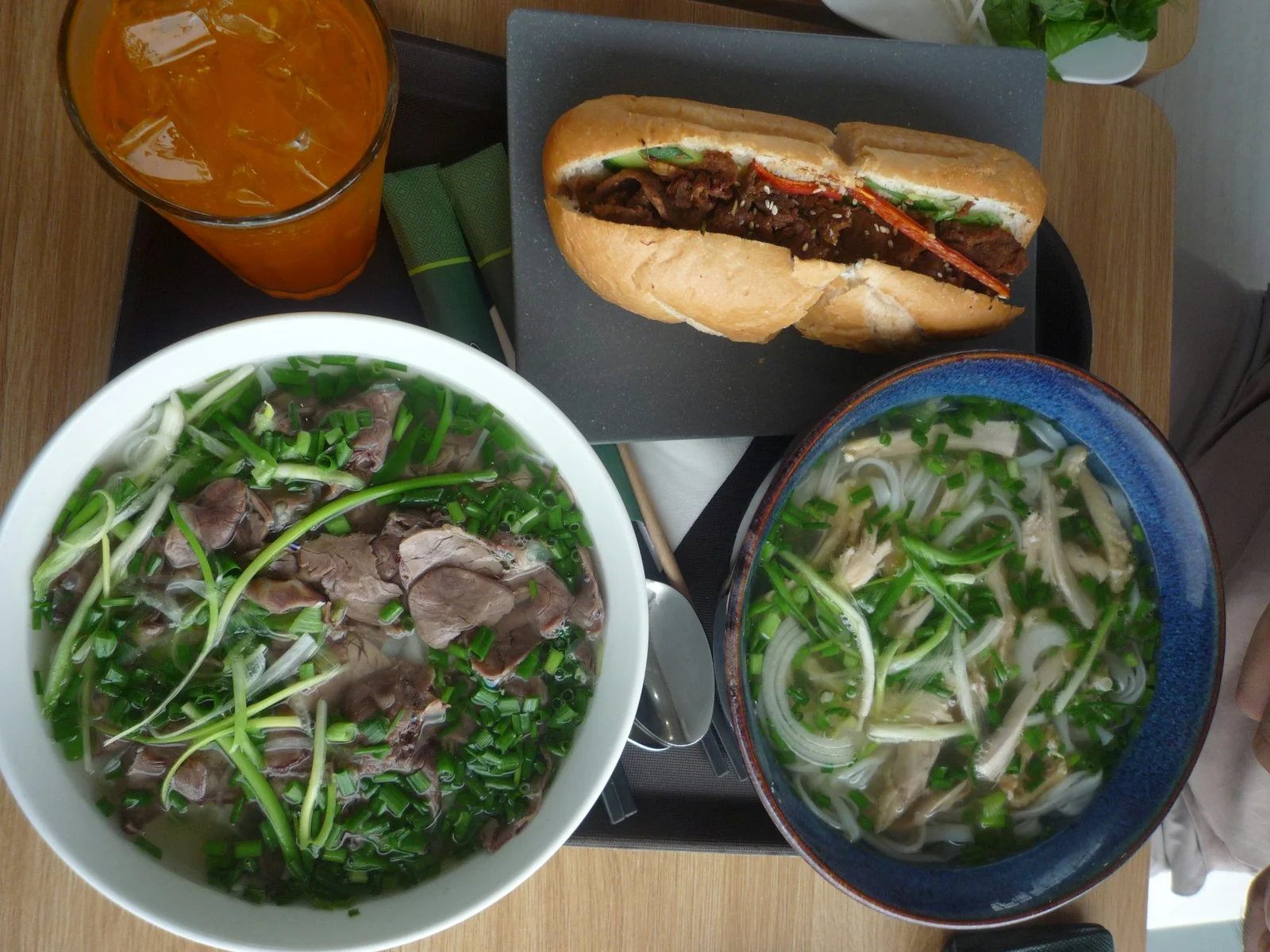
Saigon pho is sweeter and more customisable: the broth is often rounded out with rock sugar or daikon, and every table has hoisin, chilli sauce, bean sprouts and fresh herbs. Chef Luu Dong of Tre Dining, quoted by VnExpress International, says the southern broth tends to be darker and sweeter while Hanoi pho emphasises purity.
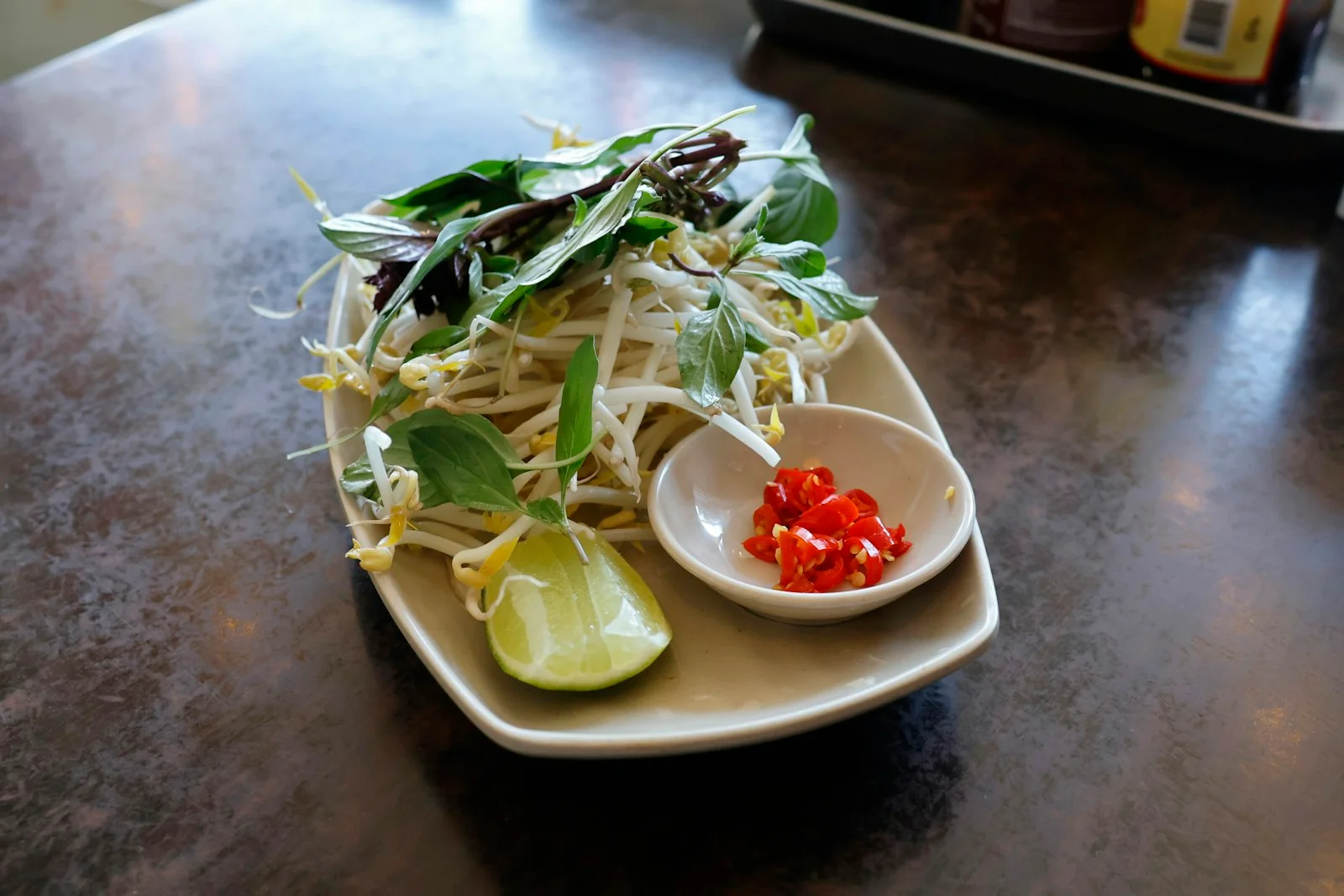
The herb plate usually carries Thai basil (húng quế), sawtooth coriander (ngò gai), bean sprouts (giá), lime and chilli. The MICHELIN Guide also lists spearmint among southern extras. Beef balls (bò viên) are a common southern topping and less usual in a classic Hanoi bowl.
Southern pho is not "less authentic". It is a regional style with its own history, and Ho Chi Minh City has long-running family shops. One example is Phở Hương Bình at 148 Võ Thị Sáu, open 06:30–21:00 daily, which has served phở gà and phở bò since 1958 and is listed in the MICHELIN Guide (checked November 2026).
Why are northern and southern pho different?
Northern and southern pho split after 1954, when many people from the north moved south and adapted their recipes to southern tastes. Southern cooking favoured fresh herbs and sweeter flavours, so the broth and the side plate changed, as the MICHELIN Guide and VnExpress both explain.
Pho itself is a northern dish from the early 20th century. Historians still debate its roots. The Hanoi heritage file lists three main theories: French pot-au-feu, a Chinese beef noodle dish, or a Vietnamese buffalo noodle soup (Nhân Dân).
Saigon was a city of migrants, so pho shops let each customer season the bowl. A northerner could keep it plain, a diner from central Vietnam could add chilli, and a southerner could add hoisin and herbs. That habit of "build your own bowl" is the clearest difference visitors notice today.
Where does Nam Dinh pho fit in?
Nam Dinh (Nam Định), about 80 km south of Hanoi, is the other northern birthplace of pho and has its own heritage listing. In August 2024 the ministry added Nam Dinh pho to the national intangible heritage list under Decision 2326/QĐ-BVHTTDL (Báo Văn Hóa).
The MICHELIN Guide notes that a northern style developed in Nam Dinh and Hanoi at the same time, helped by the province's cattle and its closeness to the capital. You will also see "Phở Nam Định" on shop signs in other cities, used as a mark of the northern style. Since Vietnam's 2025 provincial mergers, the area is part of an enlarged Ninh Binh province, though shop signs still use the old name.
How do you order pho in Vietnam?
To order pho, say the style plus the cut: "phở bò tái" is beef pho with rare slices, and "phở gà" is chicken pho. Most shops have a short menu on the wall, and you pay at the end unless the shop is self-service.
| Say this | What you get | Where you see it most |
|---|---|---|
| Phở bò tái | Thin raw beef slices that cook in the hot broth | Everywhere |
| Phở bò chín | Well-done sliced beef, usually brisket | Everywhere |
| Phở tái nạm | Rare beef plus flank | Everywhere |
| Gầu | Fatty brisket | Hanoi specialists |
| Gân | Beef tendon | Both regions |
| Bò viên | Beef balls | Mainly the south |
| Phở gà | Chicken pho | Hanoi chicken specialists, and the south |
| Đặc biệt | "Special": a bowl with several cuts | Both regions, more common in the south |
A few habits help:
- Taste the broth before adding anything. In Hanoi this is expected; in the south it tells you how much sauce you need.
- In the south, squeeze hoisin and chilli sauce into the small dipping saucer, not the bowl, if you want to keep the broth clean. You can then dip the meat.
- Tear the herbs by hand and add them a few at a time so they stay fresh.
- At busy Hanoi shops, check whether you queue, order and carry your own bowl. Phở Gia Truyền at 49 Bát Đàn is known for this self-service routine (Lao Động).
- Go early. Many specialist shops open around breakfast time, and popular cuts can sell out before the end of the day.
How much does a bowl of pho cost?
A standard bowl of pho in Hanoi costs about VND 40,000–65,000 (roughly US$1.50–2.50) at a well-known street shop, and VND 100,000 or more with extra cuts. Lao Động reported in June 2025 that Phở Gia Truyền Bát Đàn charged VND 40,000–60,000, Phở Khôi Hói VND 45,000–120,000, and Phở Gà Chăm up to VND 200,000 with premium chicken parts (Lao Động; prices change, checked November 2026).
The MICHELIN Guide marks Phở Hương Bình in Ho Chi Minh City and Phở Gà Nguyệt in Hanoi with its lowest price band (₫). For a full daily food budget across the country, see our Vietnam travel cost per day guide.
Where can you try both styles on one trip?
The easiest way is to eat pho at both ends of the country: in Hanoi's Old Quarter and in central Ho Chi Minh City. A north-to-south route such as our 2-week Vietnam itinerary naturally starts with the clear Hanoi bowl and ends with the herb-heavy Saigon version.
In Hanoi, the MICHELIN Guide lists Phở Gà Nguyệt at 5B Phủ Doãn, a chicken pho shop founded in 2009 and recognised as a Bib Gourmand (MICHELIN Guide, checked November 2026). Lists change every year, so check the current guide before you go; some well-known shops have been removed in recent editions.
Season matters too. A hot bowl is most welcome in Hanoi's cool months from about December to February, while the south stays warm all year; our guide to the best time to visit Vietnam covers the regional weather. If you are moving between the two cities, our getting around Vietnam guide compares trains, buses and flights.
Vietnam also celebrates a "Pho Day" on 12 December each year. The event was started by Tuổi Trẻ newspaper in 2017 and has been held in Ho Chi Minh City, Hanoi and Nam Dinh (Tuổi Trẻ; Nhân Dân). If you are in Vietnam in mid-December, check local news for the year's venue.
Which pho should you try first?
Try Hanoi pho first if you want to understand the dish, because the plain broth shows what a cook is doing. Try Saigon pho first if you like bright, sweet and herb-heavy food, or if you prefer to adjust the seasoning yourself.
A simple test: order phở bò tái in both cities and taste the broth before adding anything. The difference in sweetness and body is usually obvious in the first spoonful. Then, in the south, add herbs and sauces bit by bit and notice how quickly the bowl changes.
Eating phở at a pavement stall for the first time? Our guide to street food safety in Vietnam covers how to pick a busy stall, ice, herbs and the few dishes to skip.
Frequently asked questions
Is Hanoi pho or Saigon pho more authentic?
Both are authentic regional styles. Pho began in northern Vietnam in the early 20th century, and the southern style developed after 1954 when northern migrants adapted it to local tastes. Hanoi pho and Nam Dinh pho are both on Vietnam's national intangible heritage list.
Do Vietnamese people put hoisin sauce in pho?
In the south, many people add hoisin and chilli sauce, often in a small dipping saucer for the meat. In Hanoi, hoisin is rarely used, and diners season with lime, chilli or garlic vinegar instead. Taste the broth first and follow the local table.
Why is southern pho sweeter?
Southern Vietnamese cooking generally favours sweeter flavours, and pho broth in Ho Chi Minh City is often sweetened with rock sugar or daikon. The style also absorbed the southern habit of eating many fresh herbs. That is why it tastes rounder and sweeter than a Hanoi bowl.
What herbs come with pho in Saigon?
A typical Saigon pho plate has Thai basil, sawtooth coriander (ngò gai), bean sprouts, lime and chilli. Some shops also add mint or other local greens. Tear the leaves and add them a little at a time.
Is pho eaten for breakfast in Vietnam?
Yes, pho is a common breakfast in Vietnam, especially in Hanoi, where many specialist shops are busiest in the morning. Many shops stay open into the evening, and some Hanoi stalls are known for late-night pho. Go early if you want a specific cut at a popular shop.